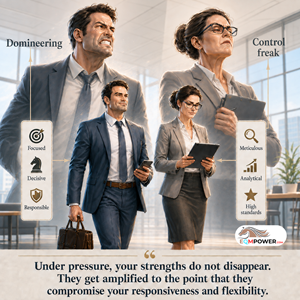
Professional stress responses don't always look like stress. That's what makes them so difficult to recognise.
Under pressure, people don't usually start behaving completely differently. More often, their existing behavioural patterns become increasingly rigid.
Someone who is naturally meticulous becomes even more meticulous. Someone who readily takes responsibility starts taking on even more. Someone who is used to making quick decisions begins making them even faster.
At first glance, there seems to be nothing wrong with this. In fact, these are precisely the qualities we are often valued for as professionals.
I certainly recognise this in myself, and I see it in the professionals I work with. People who carry a great deal of responsibility rarely abandon their usual way of operating when pressure increases. Instead, they often intensify the very behaviours that have made them successful.
Decisiveness. Reliability. Thoroughness. A sense of responsibility. Perseverance.
These are the kinds of qualities that make us competent professionals. But under pressure, they can change character. They don't disappear. They become more rigid and less responsive.
Decisiveness can turn into acting faster while considering fewer options. Thoroughness can become controlling behaviour and rigid judgement. Responsibility can mean delegating less and less. Perseverance can turn into blindly pushing ahead, even when the signals have long been telling us that a different response is needed.
This is one of the main reasons why increasing pressure in professional environments so easily goes unnoticed at precisely the stage when there is still plenty we can do about it.
We, and the people around us, often only recognise the warning signs when stress has already become prolonged or excessive. When emotions have reached breaking point, avoidable mistakes have been made, or someone has gone off sick.
After all, the professional behaviour leading up to that point still looked largely the same. Only the underlying dynamic had already changed significantly.
And that is precisely where leadership comes in.
To borrow a famous observation from Dutch football legend Johan Cruyff: “You can only see it if you get it.”
Good leadership isn't about pushing your strongest qualities harder and harder. It's about retaining the flexibility to choose a response that fits the situation.
UNDER PRESSURE, YOUR PROFESSIONAL STRENGTHS DON'T DISAPPEAR. BUT THEY CAN BECOME SO OVERAMPLIFIED THAT THEY BEGIN TO LIMIT YOUR FREEDOM TO CHOOSE HOW YOU RESPOND.
An important question to reflect on in your own leadership is therefore:
Which of your strengths becomes more pronounced under pressure — and can you recognise the point at which it starts making you less flexible?
Comments